Showing posts with label RIP IX. Show all posts

Friday, October 31, 2014

R.I.P. Deal Me In Lite: Stories by Tim Lebbon and Robert Sheckley


Deal Me In Lite, R.I.P. Edition: Week 9
"Pay the Ghost" by Tim Lebbon
"Warm" by Robert Sheckley

This is the final week of my Peril of the Short Story adventure, culminating in Halloween tonight. The final two stories from my list of thirteen were definitely a mixed bag, however. First, though, the cards:


These corresponded to two stories from two different anthologies:


"Warm" by Robert Sheckley
This story comes from the Arbor House anthology, but it was originally published in the old Galaxy magazine, one of the pulp science fiction magazines from the 1950's. It's a weird little story that is oddly effective, although it takes a little while for the reader to understand what is happening. 

The main character, Anders, is lying on his bed, waiting until it's time to go pick up his date, Judy, and take her out to a party. Suddenly he hears a voice in his head that says "Help me!" Surprisingly, Anders is not terribly concerned about this, and begins a conversation with the voice. The voice doesn't know where it is, but it can see with and through Anders, and it helps him to see the world differently as the evening progresses. With the coaching of the voice, which tells him when he is getting "warmer" or "colder" with his thinking (hence the title of the story), he becomes more and more distantly removed from the scenes around him. He begins to see other people as "articulated skeletons," "flesh machines," and even just collections of atoms. He eventually carries this kind of thinking to its logical conclusion (well, it seems logical in the story anyway) and gets in a real pickle, not to give away the end of the story. Suffice it to say, the ending is a real twist that I did not see coming, but it is entirely fitting.

"Pay the Ghost" by Tim Lebbon
This story, on the other hand, didn't do much for me -- which is a shame, really, because it's one of those stories that starts out very promisingly. And then somewhere along the way, it goes off the rails.

Lee and Kate lost their daughter, Moll, on Halloween a year before the story begins. She simply disappears from Lee's side that day after asking a very strange question: "Daddy, can we pay the ghost?" This is a question that Lee agonizes over, trying to figure it out over the weeks and months following Moll's disappearance. Predictably, Kate ends up leaving Lee, perhaps thinking that he was somehow responsible for losing Moll. Not so predictably, however, Kate now returns just a couple of days before Halloween rolls around this time, and she is completely changed. She's gaunt, sick, and half-crazed. But she claims she has found the man who is holding Moll captive. Apparently this man is holding Moll in a house along with other children. Kate convinces Lee to try and find the man and get Moll back. Lee has trouble finding the house, although he does stumble upon a burn pit near where Kate says the house is, and the pit is full of the charred remnants of bodies, and small bones. This is a tremendously disturbing image to both Lee and the reader. Soon it's clear that nothing is what it seems in this story, and the "man" holding Moll is not really a man, but something far more sinister. By this point, though, I was tremendously confused about the plot and the story just kind of fell apart for me. I wanted to like it, but... no. The ending is something of a twist, but in my book, a twist at the end only works if the reader thinks he or she understands what's happening up until that point, and I was adrift long before the ending of this story.

However, win, lose or draw, that's a wrap for both my Peril of the Short Story and my Peril the First ventures for this year's R.I.P. It was fun, and I plan to do it again next year!

Horns by Joe Hill


For the final selection in my R.I.P. Peril the First challenge, I read Horns by Joe Hill.  I chose this specifically as a counterpart to Joyland, hoping it would be an interesting father-son contrast.  I'm not exactly sure what I was expecting from this little experiment, but I can truthfully say that the talent of keeping a reader immersed in a page-turning story must be genetic, because Joe has it as much (or more, I think) than his dad.  Mrs. King is a writer as well, so we could even put together a writerly pedigree, I suppose.


The novel opens as the protagonist, Ignatius Martin Perrish ("Ig" for short, and I JUST NOW realized that his initials are "IMP" -- hmmmmmmm) awakens the morning after a drinking binge.  Ig is coming up on the one-year anniversary of the murder of his girlfriend Merrin Williams, and he would love to be able to forget about it and get over her.  Ig was accused of killing Merrin, but he was never charged in her murder for lack of evidence.

So imagine his surprise when he looks in the mirror and sees small horns beginning to grow out of his head.  And there's something else weird, too -- no one he meets actually sees the horns, or if they do, they forget about them immediately.  And they tell Ig things -- bad things -- that they want to do, and it's almost as if they are seeking his permission (or encouragement) to do them.  Ig is astounded and repulsed by this newfound power over others that he has, but he does eventually begin to use it, sometimes for "good" and sometimes for "evil" (I put those in quotes because the lines are masterfully blurred in this novel), and this alone makes for some very interesting situations.

The novel is a highly entertaining tale of Ig's efforts to both cope with his impending transformation and to find out who really killed Merrin and bring that person to justice (justice at Ig's hands, however).  And when he finds that person, he realizes that Merrin's killer is truly evil, and will require all of Ig's newly-acquired demonic "talents" to overcome.

I thoroughly enjoyed this book.  The biggest thing I liked about this story was that it was not at all predictable.  Given the premise, one might think the story would unfold in certain ways, but it never went where I thought it was going.  Plus, even though Ig is progressively turning into a demon throughout most of the book, Hill manages to make him one of the most appealing, sympathetic, and understandable characters I have run across lately.  The reader really ends up rooting for Ig pretty early in the book -- at least I did.  And the ending, once again, is not predictable in the slightest, but wholly satisfying nonetheless.


It has not escaped my attention that the movie version of this book, with Daniel Radcliffe as Ig, opens in theaters today.  I'm not a fan of movie theaters for about 23,547 reasons, but I might have to venture out to one sometime soon and see what they did with this book.

Saturday, October 25, 2014

R.I.P. Deal Me In Lite: Stories by China Mieville and Stephen Mark Rainey


Deal Me In Lite, R.I.P. edition, Week 8:
"Reports of Certain Events in London" by China Mieville
"Orchestra" by Stephen Mark Rainey

Here we are at the end of Week 8 of my special R.I.P. edition of Deal Me In Lite, and I am reading two stories again. The Mieville story comes from my McSweeney's anthology, and the Rainey story comes from the October Dreams anthology:


"Reports of Certain Events in London" by China Mieville:
I did not like this story as much as I thought I would. The premise is interesting but it's just too weird and I think it loses something trying to be so weird. Here's the premise: the author mistakenly receives a packet of documents in the mail, addressed to a Charles Melville. The documents are quite mysterious, and the bulk of the story consists of the text of the documents. They concern the members of a secret society whose function is to track and document sightings of "feral streets" -- streets from particular cities that suddenly show up in other cities, complete with their houses and everything. And it seems that these streets fight each other, and damage each other's buildings. The author put a lot of thought and creativity into the "reports," but unfortunately, they read like reports, and the "story" overall is dry and weird enough to be uninteresting to me. I can't recommend it.


"Orchestra" by Stephen Mark Rainey
This story was quite a bit better. The main character, Jacob Kravitz, is a feisty little Jewish man (his ethnicity turns out to be important for the story) who is the concertmaster for a community orchestra. The members of the orchestra are in a tizzy because their annual Halloween concert is coming up and the orchestra's conductor has gone missing. Luckily (or not, as it turns out), a man named John Hanger shows up and volunteers his services as conductor. Skeptical, Kravitz agrees to let him audition by conducting their next rehearsal, and the orchestra members are astounded by his incredible talent as a conductor, and the beautiful music he manages to extract from what is essentially an amateur orchestra. Hanger is hired as a replacement conductor, and the performance night eventually comes and is a huge success. After the concert, Hanger invites Kravitz to his apartment for a celebratory drink, and we finally find out the details about this mysterious man who, of course, has a hidden agenda. He is truly a conductor, but as the story races to its climax, we realize he makes a different kind of evil music with the souls of humans like Kravitz. As usual, I don't want to give the ending away because you really need to track down this story and read it. Suffice it to say, however, that the story has a chilling ending and is a perfect story for Halloween or any other time of year when you want a good, spooky story.

"Orchestra of the Apocalypse," retrieved from http://abstract.desktopnexus.com/wallpaper/1602356/

Thursday, October 23, 2014

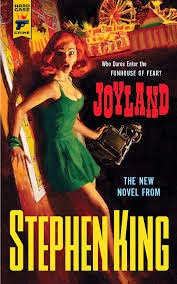
Joyland by Stephen King


This is the fourth book I read as part of my R.I.P. Peril the First activity this fall.  Joyland has been on my TBR list for forever, but I didn't actually have a copy of the book until recently, when I picked up the paperback at a local drugstore.  It seemed fitting to buy it that way, because the whole point of the Hard Case Crimes books (of which this is a volume) is to hark back to the good old days of pulp paperbacks that one would pick up from a rack at the corner store.  (In fact, even in these days of electrons and Kindles, pretty much every time I go to the drugstore I swing by the paperback books display and run my eyes over the titles, because books.)


At its core, Joyland is the story of a string of unsolved murders, all of young women and all occurring at carnivals or amusement parks.  However, it also serves as a kind of coming-of-age story for the protagonist/narrator.  Devin Jones, a college kid, happens to be spending his summer and fall working at Joyland, a beachside amusement park along the lines of something like Coney Island.  And this amusement park has a gruesome event in its history: a young woman was found dead in the haunted house ride, hours after she had been on the ride with her date, a suspect who vanished into thin air.  Now, as park lore would have it, her ghost can be seen periodically on the ride.  As Devin works at the park through the summer and into the fall, he begins to be curious about the murder, and especially begins to wonder if her murderer might still be at the park, now working incognito alongside him.

Devin also begins to make friends with a little boy named Mike, and his mother, Annie Ross.  The Rosses live in a house on the beach, and Devin sees them every day as he walks to work.  Mike has muscular dystrophy and spends much of his time in a wheelchair, and Annie spends much of her time trying to (over)protect him from every little thing.  However, Mike is ready to live a little, because he knows his time is limited, so he recruits Devin to help his mother get over her over-protectiveness. Devin helps Mike learn how to fly a kite, and eventually works it out so Mike can get his own private after-hours tour of the amusement park.  An interesting twist is that Mike has ESP (as so many of King's characters do) and can communicate with the dead.  This leads to some interesting plot developments, including the climax of the book, which includes a murderer, a hostage, and an out-of-control ferris wheel.

As an aside, what is it about carnivals and amusement parks that both attracts and unnerves us?  Maybe it's the sense that, underneath the bright lights and happy music, there's a darker underbelly that can be menacing and dangerous.  I'm sure this was not Mr. King's intention, but the climax of this book and the deal with the ferris wheel put me in mind of one of the most terrifying scenes in all of Hitchcock's movies -- the horrific carousel scene in Strangers on a Train:


That scene makes my heart race every time I watch it, even though I know what is going to happen, and this book had many similar moments.  I enjoyed reading Joyland and I would highly recommend it!

Saturday, October 18, 2014

R.I.P. Deal Me In Lite: Stories by Oscar Wilde and Robert Philips

It's Week 7 of the R.I.P. version of Deal Me In Lite, and this week the synchronicity machine broke down -- I couldn't find a single similarity between the two stories I read.  Except: they're both good.

I drew the three and Queen of spades from my "Tragic Royalty" deck:


The Queen looks pretty evil, doesn't she?  That's because she IS.

(In the background you can see part of my short story collection shelf.  So many stories to read!  I'm already gearing up for next year's Deal Me In.)

The first story this week is "The Canterville Ghost," by Oscar Wilde.  I was familiar with Wilde's works such as "The Importance of Being Earnest" and "The Picture of Dorian Gray," but not so much with anything else.  This is a longish short story, but highly entertaining and pretty humorous as well. 

The story opens as the Otis family, an American family with typical American brashness (in the eyes of Wilde, at least), buys Canterville Chase, an old English estate complete with furnishings, land, and a resident ghost.  The family, being a modern American family, pooh-poohs the idea of a ghost, despite all the warnings to the contrary.  Their first encounter with the supernatural consists of a mysterious blood stain on the floor of the sitting-room which has never been able to be removed.  One of the family members whips out a tube of Pinkerton's Champion Stain Remover and Paragon Detergent, and promptly makes the stain disappear, to the consternation of the housekeeper.  And this sort of becomes the theme to the story.  There IS a ghost, and he tries his best to scare the family and make them believe in him -- and they DO eventually believe in him, but after a fashion: they begin to play tricks on him and try to thwart his every effort at haunting.  It's a truly amusing story (although I think Wilde goes on a little too long with the gag), and it eventually winds up to an interesting and satisfying conclusion.

The second story this week was "A Teacher's Rewards" by Robert Philips.  Old Miss Scofield, a retired schoolteacher, gets a visit from a former student, Raybe Simpson.  She doesn't remember him at first, although he certainly remembers her.  And unfortunately, she remembers him too... at the end, when it's too late.  This story is an interesting game of cat and mouse on the part of the author, where he leaks out one little detail after another, all of the details adding up to a more and more unsettling story.  As it turns out, Raybe is fresh out of prison, and while he was locked up, he got to wondering how he ended up there.  He decided it was his mistreatment as a child in Miss Scofield's class, from her and his classmates, so he has come to visit her and settle up some old scores.  This is an excellent story with a type of horror that gradually creeps up on the reader and produces a good old-fashioned shudder at the end.

Saturday, October 11, 2014

R.I.P. Deal Me In Lite: Stories by H.G. Wells and E.F. Benson


It's the sixth week of my R.I.P. "Peril of the Short Story" version of Deal Me In Lite, and this week I start reading two stories each week in order to get to the magical number of 13 by the end of October.  And this turned out to be a very interesting event.  There's already a lot of serendipity built into the Deal Me In method of reading, but when you pick and read two stories together, you can achieve even greater levels of serendipity, as I found out this week.

So for this week I chose the Ace and two of spades from my "Tragic Royalty" deck of cards:


The Ace corresponded to "The Red Room" by H.G. Wells, and the two corresponded to "How Fear Departed From the Long Gallery" by E.F. Benson.  Both of these stories are available on the Internet, but I got them from an anthology I have owned for quite some time, Ghosts, edited by Marvin Kaye:

Yes, that is Edward Gorey artwork on the cover.  I found an image that shows the entire dust jacket because it's really wonderful and highly appropriate for this book.

Both of these stories involve a person who spends time in a haunted room -- but one spends time there on purpose (because they don't really believe it is haunted) and the other KNOWS the room is haunted and gets trapped there by accident.

In "The Red Room" by H.G. Wells, the narrator proposes to spend the night in a haunted room, the so-called "red room" of Lorraine Castle, in which braver souls than he have spent the night, and died there.  The servants, who are elderly and who have lived through the history of the house, do their best to dissuade the narrator from this foolhardy act, but he is determined to do it.  As he makes himself comfortable (if that word may be used here) in the room for the night, he tries to dispel the overwhelming gloominess and darkness of the room with candles that he lights and sets up in various nooks and crannies of the room.  Then the candles start going out, in various combinations.  Is it a draft?  Or something more sinister?  Eventually the candles all go out at once, and the fire goes out as well, and the narrator is thrown into a terrified panic.  He runs around frantically in the dark, trying to find the door of the room, and knocks himself out on a piece of furniture.  Not to spoil the story for you (because it's really not much of a story, although very well-written and interesting), the next morning the narrator comes to the conclusion that what really haunts the room is Fear itself.

This leads us to the synchronicity with the second story I read this week, "How Fear Departed From the Long Gallery," by E.F. Benson.  Let me just take a moment and make another plug, as I have before, for E.F. Benson as one of the more underrated modern British novelists (modern as in the early 20th century).  I have waxed eloquent about the pleasures of his Lucia novels elsewhere on this blog, and in my opinion this gem of a story is another example of his expert way with a tale.  I have never read much of his other work besides the Lucia novels, but apparently Benson is also well-regarded for his ghost stories, of which I believe he wrote several.  If they are anything like this one, I will have to hunt down the others and read them too.

In Benson's story, the Peveril family lives in a house that they know is haunted; in fact, they co-exist happily with several different family ghosts, and take a kind of pride and pleasure in interacting with their long-dead ancestors in this way.  This part of the story is actually pretty humorous, in Benson's typical understated, droll style.  However, there is one pair of ghosts that the family fears: the ghosts of twin babies that were brutally murdered by the ruthless Dick Peveril, so he could inherit the estate instead of them.  This murder, which involved throwing the babies into a fire, happened in the long gallery, and ever since then, the ghosts of the babies have haunted that room.  They appear only once or twice a year, and only in the dead of night, but the family is terrified of seeing them, because everyone who has ever seen their ghosts has died a horrible, gruesome death.  So every member of the family simply makes sure to stay out of the long gallery after dark, and they make sure their houseguests know this rule as well.


So this sets the stage for a New Year's Eve party where the family is hosting several guests, including Madge Dalrymple, who unfortunately twists her knee skating on the lake.  Madge decides to rest her leg by sitting in front of the fire in the long gallery.  She's warned not to forget about being in there after sunset, but of course you know what happens next.  Madge falls asleep over her book and wakes up right at dusk.  When she realizes what time it is, she becomes terrified, and of course the twin baby ghosts show up soon after.  What happens next, though, is an interesting twist on the traditional ghost story, and this ghost story actually turns out to have a happy ending.  It's not a sappy, tacked-on happy ending though -- it fits the tone and plot of the story perfectly.

I enjoyed both of these stories and would highly recommend both of them.  Look them up and let me know what you think!

Sunday, October 5, 2014

Harvest Home by Thomas Tryon

Harvest Home, by Thomas Tryon, has been on my Kindle TBR list FOREVER.  So when I was fishing around for ideas about the books to put on my R.I.P. Peril the First list, I knew I had to read this book.

Ned Constantine, his wife Beth, and their teenaged daughter Kate have just moved from New York to the sleepy little New England hamlet of Cornwall Coombe.  It's a place so traditional in its outlook that the villagers look askance on the use of something as basic as a tractor for getting their farming done.  And make no mistake, farming and their (only) crop, corn, is something they take VERY seriously in Cornwall Coombe.  Their entire year revolves around the planting and harvesting of the corn, with their major festivals which including Planting, Days of Seasoning, Tithing Day, the Corn Play, and the last and most mysterious, Harvest Home.


Even though this novel has what might now be regarded as something of a hackneyed plot (it might have been much more original when the book first came out in 1973, I don't know), Tryon successfully avoids making the characters too stereotypical, I think.  One of the major characters of the book is the Widow Fortune, who seems to be a creepy old lady when she first appears in the story, riding around in her horse and buggy, and wearing a little white cap (think Amish style).  Then, due to several important and plot-turning events, the reader gradually comes to trust her as a stern but ultimately kind-hearted and beneficent matriarch who watches over the welfare of everyone in the village.  Then.... the tables turn again.  OK, she IS a creepy old lady who is capable of pretty much anything.  She doesn't see herself this way, of course, but she's basically evil.

Bette Davis as the Widow Fortune in the made-for-TV movie version of the book (see below)

Other creepy events and pieces of information find their way into the narrative, gradually adding to the unease the reader keeps trying to push away.  The Constantines' next door neighbors are the Dodds -- Maggie and Robert.  Robert is blind, and the sound of his "books on tape" (although back in the 1970's it was more like "books on vinyl") floating in from the house next door is an ever-present background to the Constantines' lives.  One day Ned helps Robert put in his eyedrops and discovers that Robert is blind because his eyeballs are completely gone.  Hmmmm.......

Then there's the mystery of Gracie Everdeen, a villager who is now dead but whose grave is the only one outside the confines of the cemetery, as if she were being shunned even in death.  And no one really wants to talk about what happened to her, except that whatever she did brought on the last poor harvest, what the villagers call the "Great Waste."  Hmmmmm.........

And how about Missy Penrose, a creepy little girl who serves as the village's oracle, not only doing relatively innocent things like choosing baby names for expectant mothers, but also choosing the young man who will be the "Lord of the Harvest" for the coming seven years?  Oh, and she chooses the Lord of the Harvest by dipping her hands in the blood and entrails of a freshly-slaughtered sheep before walking around a circle of the young men and placing her bloody hands on the face of the one she chooses.  (Now you just can't tell me that's normal, I don't care who ya are.)  Hmmmmm.......

I could go on and on, but I think you get the idea.  This novel is CREEPY.  And an excellent read!

The progression of events in this novel, a kind of slippery slope to the inevitable, is one of the main things that makes it so effective.  The reader watches as Ned goes from being enchanted with his new home of Cornwall Coombe, to being irritated at the old-fashioned ways and attitudes of the villagers, to being suspicious of what is actually going on behind the scenes, to the final stage of understanding the lengths to which the villagers will go to preserve their way of life.  It's like watching pretty much every horror film ever made, where you are yelling at the characters NOT to look behind that door, NOT to go down into the dark cellar, NOT to go find out what made that weird noise outside -- and secretly hoping that they WILL.


The book was adapted into a TV miniseries movie, "The Dark Secret of Harvest Home," in 1978.  The cast included Bette Davis as the Widow Fortune.  It's available in parts on YouTube, and I did watch a little bit of it after reading the novel.  It's supposed to be relatively faithful to the plot of the book (an increasing rarity these days) but the book has to be much more entertaining.  Plus, 1970's TV miniseries -- need I say more?

In short, if you are looking for a scary-ish, spooky, creepy autumnal read, you could do far worse than this book.  I highly recommend it!

Friday, October 3, 2014

"Lusus Naturae" by Margaret Atwood


Deal Me In Lite, R.I.P. Edition, Week 5: “Lusus Naturae” by Margaret Atwood (Story 5 of 13)

I have a confession to make: I would read Margaret Atwood's grocery list.  Any kind of words she wants to put down in any order would be OK by me.  I think she is one of the most interesting and inventive writers today.  So when I saw her story "Lusus Naturae" in my McSweeney's anthology, I knew it had to go on the R.I.P. Peril of the Short Story list.  And this week, the 5 of spades dealt it up for me.


"Lusus naturae" is Latin for "a freak of nature," and that's what the narrator of this story admits to being.  She is a nameless young girl whose family does not know what to do with her, except they know they cannot keep hiding her any longer.  We never get any real picture of what she looks like, but she refers to her yellow eyes, pink teeth, hairy face and body, and red fingernails -- so the "lusus naturae" terminology is apt.

The family decides that she should "die," so they fake her death and burial.  Oddly, this gives her more freedom than she has ever known before, as long as she stays out of sight.  Completely self-aware and intelligent, she uses her new-found freedom to educate herself by reading and trying to learn about the world.  But she has a penchant for roaming around at night, and it is this which finally becomes her undoing.  Stumbling upon lovers meeting furtively at dusk, she mistakes them for creatures who are in the preliminary stages of becoming like her, and she is oddly, irresistibly, and tragically drawn to them.  The story ends rather predictably but Atwood's decision to write the story from the point of view of the monster gives the ending a great deal of nobility and redemption that it would not have otherwise had.

I enjoyed this very short story.  It was well-written and suitably creepy for my R.I.P. short story enterprise.  Atwood has a new short story collection that's just come out, and you'd better believe it's on my wishlist!

Monday, September 29, 2014

The House of the Seven Gables by Nathaniel Hawthorne


As part of my R.I.P. activity this autumn season, I signed up for the House of the Seven Gables readalong being hosted by Michelle at Castle Macabre.  I approached the project with fear and trembling because, although I have enjoyed almost everything of Nathaniel Hawthorne’s work that I have ever read, I knew that he is never a quick read.  And with everything that I customarily have going on in the fall, plus having signed on for the reading of four other books during the R.I.P. season – well, I knew this was going to be a challenge all by itself.  It was, but I paced myself and typically read a chapter a day, beginning on the second day of September.  The result?  I’ve finished it!  And I am glad I read it, but it’s by no means my favorite of Hawthorne’s works.
 
I am probably the last person in this or any other universe to have read The House of the Seven Gables, plus this is undoubtedly a book that many people have been forced to read, either as part of their high school or college studies.  Plus, Wikipedia (link).  So you don’t need me to say much if anything about the plot.
 
However, just in case you DO, here’s the Cliff Notes version of the Cliff Notes:
 
The Pyncheon family are the owners and builders of the massive, brooding house known as the House of the Seven Gables.  However, the house sits on land that originally belonged to a man named Matthew Maule, who was swindled out of the land by old Colonel Pyncheon, the stern and possibly evil progenitor of the family.  In a prefatory chapter, Hawthorne relates the events that set everything in motion in the novel.  Pyncheon wanted Maule’s land but Maule wouldn't consider any offer.  This went on for way longer than Pyncheon would have liked, so he finally accused Maule of being a witch and had him executed, which cleared the way for his landgrab.  However, before he died, Maule cursed the family with a curse that God would give them blood to drink, and as the novel develops, this curse is borne out in a variety of ways.
 
The story then fast forwards to the “present” (Hawthorne’s time, I suppose) and focuses on two Pyncheon descendants, Hepzibah and her brother Clifford, as well as a cousin, Phoebe, who comes to live with them in the house.  Hepzibah and Clifford are typical gloomy Pyncheons, with plenty of skeletons in their closets, but Phoebe is a breath of fresh air and gradually transforms the house, or at least its occupants.  There’s a dark cloud on the horizon, however, in the form of Judge Jaffrey Pyncheon, another cousin who has malevolent designs on the family members and does his best to be nasty to them, all in the guise of being concerned about his cousins.  He gets his in the end, thankfully for the reader’s sense of justice, and the chapter in which Hawthorne dwells on Jaffrey’s end and its aftermath struck me as a real tour de force.

There’s another inhabitant of the house, a lodger named Holgrave, who is typically referred to as "the Daguerreotypist," a reference to his trade.  He, with Phoebe, seems to be a force for good in the house, but the reader soon suspects that there is more to him and his identity than meets the eye.  In case you have not read the book, I certainly am not going to spoil it for you, but I’ll just say that Holgrave is part of a very satisfying climax and denouement of the story.

This is a picture of the house that belonged to Hawthorne’s cousin Susannah Ingersoll, which apparently gave him the idea for the title of the novel.  It does resemble Hawthorne’s descriptions of the old Pyncheon place.

As I mentioned earlier, I am glad I read this book, even though it was rough going for me at times.  Hawthorne makes too many diversions into episodes that don’t have much to do with pushing the story along, and as I’ve mentioned elsewhere, he never uses one word when he can use 10.  Or 20.  Or 100.  And it’s kind of a weird story, after all, although perfectly suited to the season of gradually lengthening nights and strange, spooky things around every corner.  BUT.  After all is said and done, it's unique, and I think it definitely deserves its place in the pantheon of great American literature.

Wednesday, September 24, 2014

"Shut a Final Door" by Truman Capote


Deal Me In Lite, R.I.P. Edition, Week 4: “Shut a Final Door” by Truman Capote (Story 4 of 13)


For the fourth story in my R.I.P. Short Story Peril, the spades dealt me a Jack. This means I turn again to The Arbor House Treasury of Horror and the Supernatural for a weird little story by Truman Capote. According to the short introduction in the anthology, this was one of Capote’s earliest stories, written before his first novel Other Voices, Other Rooms. This story also won first place in the O. Henry prize competition of 1948. It is an interesting story, but I'm not so sure it's worthy of its place in a horror anthology.


The protagonist, Walter Ranney, is a vile little man with little to nothing of a moral compass. And that's going easy on him. He's one of those people who drifts from thing to thing, and person to person. He makes friends with a young man only to steal his girlfriend away from him. And then he uses the new girlfriend to advance in his career, and eventually as a stepping stone to a new girlfriend. In fact, he pretty much uses every woman in his life that way, always “trading up,” as they say. Until he ticks off his last girlfriend, an important heiress, and goes plummeting back down to the bottom of the ladder, even losing his job.


The supernatural part of the story, I guess, comes in when Walter begins getting calls from an person who refuses to identify himself or herself (Walter can’t even tell if it's a man or a woman) and simply keeps saying, every time they call, “Oh, you know me, Walter. You’ve known me a long time.” We never get even a hint of who this is (and I have my own suspicions as to what Capote is trying to do with this but I won't tell them to you for fear of spoiling the story) but it's definitely a little on the creepy side.


I don't think this is really supposed to be a scary story, so I was a little disappointed that it got into my R.I.P. mix. It's really more of a psychological study/morality tale kind of thing. However, as a short story it stands very well on its own merits and I'm glad I read it. It's one of those stories that I had to read twice to make sure I was catching even half of what Capote was trying to do with it, but it was definitely worth reading that way.

Wednesday, September 17, 2014

"Rappaccini's Daughter" by Nathaniel Hawthorne


Deal Me In Lite, R.I.P. Edition, Week 3: "Rappaccini's Daughter" by Nathaniel Hawthorne (Story 3 of 13)

For week 3 of the R.I.P. version of Deal Me In Lite, I drew the 10 of spades, which led me to the classic "Rappaccini's Daughter" by Nathaniel Hawthorne.  Although I have no doubt this story is widely available online, I read it out of The Arbor House Treasury of Horror and the Supernatural, an anthology I have owned for many years and which has always served me well at this time of year.


I have read this story before -- I think maybe in high school or college -- but I didn't remember it at all, so I thought it was a worthy choice for my R.I.P. short story list.  Plus, there seemed to be a chance at some synchronicity since I am also reading my way through The House of the Seven Gables as part of the Castle Macabre readalong.  I have never had so much Hawthorne in my diet (ha) and I'll say one thing about him: good old Nathaniel never used one word when he could use ten.  But in spite of all his verbosity, the man can tell a story.  By the way, did you know that the villainess Poison Ivy from the Batman comics is based in part on this story?  It's true (according to Google!).


The story opens as a young student, Giovanni Guasconti, procures lodgings for himself in Padua.  His window overlooks a beautiful garden which he later learns is owned and tended by a certain Dr. Rappaccini.  Not only does Rappaccini own this beautiful garden, he also has a beautiful daughter named Beatrice.  Once Giovanni sees her, it's love at first sight, of course.  However, there's something not quite right about the garden or Beatrice.  The flowers and plants in the garden look strange to Giovanni, and he eventually learns that they are the products of Dr. Rappaccini's unusual experiments, as is Beatrice herself.  Giovanni sees some things in the garden that alarm him (I'm not going to spoil it for anyone who has not read this story), but like the proverbial moth and flame, he cannot stay away from his window and eventually makes his way into the garden and into Beatrice's heart, with tragic consequences.

Although this is one of the classic short stories, it's not particularly scary.  Creepy and suspenseful, maybe, but not scary.  However, it's only the middle of September, so there's still plenty of time to fire up the big guns of horror and the things that go bump in the night.

Thursday, September 11, 2014

"What You Do Not Know You Want" by David Mitchell


Deal Me In Lite, R.I.P. Edition, Week 2: "What You Do Not Know You Want" by David Mitchell (Story 2 of 13)

For Week 2 (and Story 2) of my R.I.P. version of Deal Me In Lite, I selected the 6 of spades which led me to a story from a most interesting anthology, McSweeney's Enchanted Chamber of Astonishing Stories, edited by Michael Chabon.  Three or four of the stories on my R.I.P. short story list come from this anthology, and the initial story I picked, "What You Do Not Know You Want," did not disappoint.


The story revolves around an item from a real-life incident, the death by seppuku (ritual suicide by disembowelment, otherwise known as hara-kiri) of Yukio Mishima, the notable Japanese actor, poet, playwright, and film director (picture at left).  The narrator of the story, whose name we never find out, is a dealer of esoteric and exotic antiques, and he is on the trail of the dagger that Mishima used to kill himself.  He rightly figures that it would be worth a lot of money to the right customer, and he just happens to have one lined up.  However, as the story opens, the narrator is in a hotel in Hawaii, looking for clues about the death of his business partner, who killed himself by jumping off the hotel roof.  The dagger, which he was supposed to be procuring, is also missing.  His search for the dagger and the outcome of that search is the rest of the story.

The narrator has nicknames for everyone: his business partner is "Vulture," his fiance (whom he is planning to marry for her money primarily) is "Nightingale," and the proprietor of the hotel where Vulture died is "Werewolf."  Another character, a young Chinese girl who is supposed to be the proprietor's niece, is named Wei, and this appears to be her real name.  I think there might be some significance there, but I would have to read the story another time or two to see if I am right.  The narrator has quite a few run-ins with Wei, as it turns out, and we feel an undercurrent of danger in their interactions with each other, but we never quite understand exactly what it is -- until it's too late.

The entire story has a kind of hard-boiled, noir-ish feel to it as the narrator hunts down the dagger in some very seedy and dangerous locales.  Add to this the nightly screaming of someone a few rooms down from the narrator's room, and you have the ingredients for a highly atmospheric and unsettling story.  By the way, the title of the story (which was the reason I chose it) comes from the phrase on the narrator's business cards.  By the end of the story, this phrase has been given new significance with a shocking twist that puts a special spin on it.

I did not know it when I chose this story, but the author just also happens to have written Cloud Atlas and The Bone Clocks, the latter of which appeared on this year's Man Booker Prize longlist (but not the shortlist, as was announced a couple of days ago).  I found this story riveting and suitably creepy, a perfect story for my R.I.P. reading, and it makes me eager to read more of Mr. Mitchell's stuff.  Have you read any of his works?

Saturday, September 6, 2014

"The Trick" by Ramsey Campbell

Deal Me In Lite, R.I.P. Edition: "The Trick" by Ramsey Campbell (Story 1 of 13)

As part of my participation in R.I.P. (Readers Imbibing Peril) this year, I am doing the "Peril of the Short Story" to add to my Deal Me In Lite activity.  (Click that link for a list of the stories I will be reading.)   I'm using a special deck of cards to pick the 13 stories of the Peril, the Bicycle Tragic Royalty set.  Here's what the suit of spades looks like:


The pips on the number cards have a little decoration, but the face cards are the real highlight of this deck.  They are creepy!  And according to the packaging, they glow in black light.  I don't have a black light, so I haven't tested that out yet.

The backs of the cards also have a suitably creepy design, for Bicycle cards:


So, on to the story!  This week my assignment was to read one story, and I chose the eight of spades which led me to "The Trick" by Ramsey Campbell, from the anthology October Dreams.  If you do not have this anthology, it is well worth the money.  It's filled with all kinds of modern Halloween stories and essays plus authors' reminiscences of "My Favorite Halloween Memory."  It's a unique and excellent anthology.


"The Trick" is a weird, creepy, and somewhat confusing story.  The story opens as a young girl named Debbie, and her best friend Sandra, are getting ready for Halloween.  Debbie lives across the street from an old woman that she believes to be a witch.  Witch or not, the old woman is disliked by pretty much everyone in the neighborhood -- she's mean to both people and animals, and lives in a dilapidated house with an unkempt, wild yard.  However, no one will say anything to her or against her, because they are all secretly afraid of her.

On the morning of Halloween, Debbie and Sandra decide to visit an old abandoned railway tunnel near their house.  The witch sees them and essentially loses it, telling them to stay away from there.  They get the impression that she's hiding something there, but they don't know what.  That evening, as they make their rounds of the neighborhood trick-or-treating, they go to the witch's house and she gives them each a piece of homemade candy.  There's clearly some kind of magic associated with the candy, but it's never clear exactly what the candy does.  At first it seems as if it may be some kind of drug, because Debbie goes on a weird and spooky expedition to the tunnel with Sandra in the middle of the night, looking for Sandra's dog which has run off.  There they meet the witch plus some other unsettlingly creepy friends of hers.  Debbie wakes up and it appears to have been a dream.  But further events transpire (as in all good scary stories) to suggest that maybe the events of the dream were more real than the characters first imagined.

I liked this story well enough.  But as in my thoughts on The Haunting of Hill House, I really don't care for stories where the author is SO obtuse that the reader gets confused and wonders what is really going on.  This story was a little like that.  However, it was a fine start for my R.I.P. short story project.

Thursday, September 4, 2014

The Haunting of Hill House by Shirley Jackson

I read this novel as part of the R.I.P. (Readers Imbibing Peril) event, and also as part of the Estella Society readalong taking place all during September.


The only Shirley Jackson I have read before, to my knowledge, is the famous story "The Lottery."  A classic, to be sure.  The Haunting of Hill House is supposed to be a classic as well, but it left me a little cold.  And not in the good, scary story way.

Here's the setup, in case you are unfamiliar with this book: Dr. John Montague is an anthropologist who has taken an extreme interest in supernatural dealings, especially haunted houses.  Hill House comes to his attention as a suitably haunted house for him to study and eventually write a masterful treatise about.  But he needs assistants to help him explore and understand the house.  He chooses two assistants, Eleanor Vance and Theodora, by their demonstrated links to the paranormal.  (As a child, Eleanor lived in a house that experienced a rain of stones for days, and Theodora has demonstrated remarkable ESP in experiments conducted in Dr. Montague's lab.)  The third assistant, Luke Sanderson, is a nephew to the owner of Hill House, and thus an heir.  His presence is the only condition upon which Dr. Montague will be allowed to make his observations of the supposedly haunted house.

Thus the stage is set for what seems to be a typical ghost-hunting story.  And the first part of the book is essentially that.  It's creepy, and a little suspenseful, and I enjoyed that part of the book very much.  Hill House is indeed haunted, and a really creepy and weird place to boot, but it's not haunted in the way that I expected.   This story turns out to be more about psychological terror, and the effect the house has on Eleanor in particular, and it was that part of the story that I had trouble relating to.  It just wasn't that scary, and I was even a little confused by the storyline from time to time.  Many of the supernatural events in the book are only hinted at obliquely.  For example, in one scene Eleanor thinks she is holding Theodora's hand in the dark, to keep from being scared.  Suddenly she realizes that it might not be Theodora's hand, and she doesn't really know whose it is, since no one else is supposed to be in the room with them.  And.......... that's all we get of that.  Creepy, yes.  Scary, no -- because there's just not that much there.

I sort of kept waiting for things to happen like that all through the book.  Scary, creepy things do happen eventually, and some of them are kind of surprising.  Overall, however, I thought the story as a whole was unsatisfying.  Too much is left unsaid, or ambiguous, and that's not the kind of scary story I want.

This book just was not my cup of tea.  It's not a long book, so it can be read pretty quickly -- I finished it in just a couple of days.  There are many people (including masters such as Stephen King) who regard this as one of the best horror novels ever written, and I don't have any reason to doubt their judgment.  The book is short enough that I would be willing to reread it someday and give it a second chance.  But for now, my verdict is.... eh.

If you've read it, and liked it, and maybe understood it better than I did, please talk about it in the comments!

Sunday, August 31, 2014

Readers Imbibing Peril (R.I.P.) IX


After taking some baby steps along the lines of getting this blog up and running again, rolling through my version of the Deal Me In short story challenge, and successfully completing the Beat the Heat Readathon, I think I am ready to embark on a reading challenge that is one of the longer-running and more entertaining ones out there.  I am speaking, of course, about the Readers Imbibing Peril (R.I.P.) challenge, now in its ninth year.  It's hosted by Carl at Stainless Steel Droppings, and it's a veritable institution this time of year.  When the days start to grow shorter, and the temperatures start to moderate (I would say "cooler" but I do live in south Mississippi, after all, and we don't really start to get much cooler weather until the end of October or the beginning of November, if even then) -- when autumn starts to make its presence felt, one naturally feels drawn to reading that reflects the season.  In other words, spooky, eerie, unsettling stories and novels become part of the bill of fare.

The R.I.P. challenge runs from September 1 to October 31, and Carl has a number of ways readers can participate.  I've decided to tackle "Peril the First," which involves reading four books.  I plan to include The Haunting of Hill House by Shirley Jackson as one of these four (see below) so maybe that won't be too bad, killing four birds with three stones, I guess (?).

So the four books I will be reading for R.I.P. this year are:
1. The Haunting of Hill House by Shirley Jackson (review)
2. Joyland by Stephen King (review)
3. Horns by Joe Hill (review)
4. Harvest Home by Thomas Tryon (review)

The Jackson is a two-for-one read, as previously mentioned.  The King and Hill I thought would be interesting as a father-son dual read.  And the Tryon has been on my Kindle for some time and needs to be read -- and what better time than Autumn??

What spoke to me even more strongly, however, given my recent foray into the Deal Me In challenge, was this:


Yes, friends and neighbors, there's a peril just for readers of short stories, and there are no rules or limitations on how many can/should be read.  I definitely plan to do this one, AND I am going to do it in true Deal Me In fashion.  How? you may ask.  LIKE THIS:


These playing cards will fit the bill nicely, and I've already ordered a set (from Amazon -- you can get your own set here).  I'm pretty excited about using these cards to select the short stories I will be reading for R.I.P. IX.  The plan is to read one a week in September (because I will still be doing Deal Me In as well as one of the other Perils), and then two a week in October, as we get close to the big day of Halloween.  The calendar cooperates very nicely as well, because this means I will be reading THIRTEEN stories, a great number for this kind of challenge, plus of course it's the number of cards in a suit.  I want to see what the cards look like when I get them in a few days, but I think I will be using spades as the suit for selecting my stories.  It's usually the suit that Jay at Bibliophilopolis uses for "darker" stories.

No matter which suit I use, here is the list of stories I plan to read, culled from a variety of spooky/creepy/weird anthologies which I have always gravitated towards anyway:

Ace: “The Red Room” by H.G. Wells (review)
2: “How Fear Departed from the Long Gallery” by E.F. Benson (review)
3: “The Canterville Ghost” by Oscar Wilde (review)
4: “Pay the Ghost” by Tim Lebbon (review)
5: “Lusus Naturae” by Margaret Atwood (review)
6: “What You Do Not Know You Want” by David Mitchell (review)
7: “Reports of Certain Events in London” by China Mieville (review)
8: “The Trick” by Ramsey Campbell (review)
9: “Orchestra” by Stephen Mark Rainey (review)
10: “Rappaccini’s Daughter” by Nathaniel Hawthorne (review)
J: “Shut a Final Door” by Truman Capote (review)
Q: “A Teacher’s Rewards” by Robert Phillips (review)
K: “Warm” by Robert Sheckley (review)

A couple of these are stories I have read before (such as the Hawthorne) but they all should be interesting.

Oh, and I'm pretty sure I want going to do this too:


Fall is just a great time for reading, and I simply cannot resist stuff like this!

UPDATE: Since I am clearly a glutton for punishment, I am going to make my Peril the First even more perilous, with the addition of this readalong at Castle Macabre:


Yes, #5 on my list of books is going to be The House of the Seven Gables by Nathaniel Hawthorne (review).  It will go well with "Rappaccini's Daughter" on my short story list, and it's another of those books I feel like I should have already read.  Whether I finish all this reading or not, I have a feeling it's going to be an exciting Fall!