Showing posts with label Stephen King. Show all posts

Monday, February 11, 2019

DMI2017, Week 29: "Mister Yummy" by Stephen King

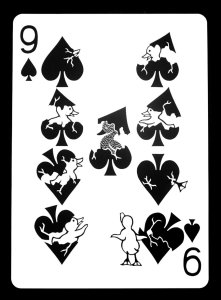
nine of spadesBazaar


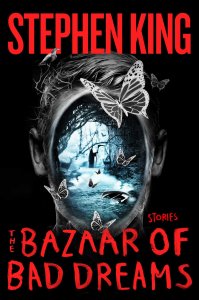
This week’s story, brought to us by the Nine of Spades, comes once again from Stephen King’s newest (I think) collection of short stories, The Bazaar of Bad Dreams. One of the things that makes this collection so interesting (besides, of course, the excellent stories themselves) is King’s short preface to each story, wherein he gives some background or insight into why he wrote the story or where he got the idea for the story.
For the story “Mister Yummy,” King recalls talking to a friend about wanting to write a story involving gay men in the era of AIDS. His friend told him that he probably didn’t have anything new to say about AIDS, especially as a straight writer. But King strongly disagrees, and this story bears out the validity of his viewpoint. King says that the power of the human imagination is such that anyone should be able to write a story about anything. He points out that when we talk about imagination, we’re really talking about empathy — it all just boils down to understanding what it’s like to be someone else. If we as a society have lost the ability of empathizing with others in our world, then there’s no hope for us. I completely agree with King here.
The other thing I liked about this story was King’s use of Poe’s “The Masque of the Red Death” as a sort of counterpoint to the events of the story. I took the opportunity this week to re-read that story, so in case you haven’t read it, here’s a brief synopsis: despite the best efforts of Prince Prospero to protect himself and everyone in his castle from the menace of the Red Death, he fails. One night during a masquerade ball, The Red Death sneaks in — disguised, oddly enough, as the Red Death.
In “Mister Yummy,” King turns the tables on Poe’s idea. In this story, Death appears as a beautiful, sexy, and utterly desirable young man who shows up one night at a gay bar in the era of AIDS. The story is being told many years later by Ollie Franklin, an elderly gay man living in an assisted living facility. Ollie and his friends nicknamed this young man “Mister Yummy,” and now Ollie is reminiscing about him because he has seen him in various places around the retirement home. The odd thing is, Mister Yummy looks exactly as he did the night Ollie first saw him, decades ago. He begins to think that Mister Yummy is really Death, and is coming for him soon. Every time he sees Mister Yummy, he’s closer and closer, and eventually he will show up in Ollie’s room, and that will be the end.
He tells all this to his friend, Dave, who is more or less incredulous. However, Ollie is insistent that he’s going to die soon, and wants to give Dave his most treasured possession, an antique pocket watch, so his good-for-nothing younger brother won’t get his hands on it. Dave agrees to take it, and soon after, Ollie is discovered in his room, having died peacefully in his sleep.
Dave, of course, has his own “Miss Yummy” that he remembers from his youth, a beautiful young redhead with a too-short skirt that had the propensity to ride up at opportune moments, and it’s not too long before he sees her standing next to the fountain outside the nursing home.
There’s not a whole lot more to the story than that, plot-wise, but this is a beautifully written story that definitely rewards the reader. I also found it a bittersweet meditation on aging and memory, as Dave thinks about his life in the retirement home, and what it all means.
Rating: 5 stars; I have a feeling this is a story I’ll be re-reading many more times.
Deal Me In 2017 is hosted by Jay at Bibliophilopolis.

Sunday, July 2, 2017

DMI2017, Week 26: "Quitters, Inc." by Stephen King

This week the Six of Spades brought me another oldie but goodie from the pages of Night Shift.


Richard Morrison is a typical American businessman -- he smokes, drinks, and eats too much. One day he meets an old friend, Jimmy McCann, in an airport bar, and Jimmy looks great. He has stopped smoking, and he tells Morrison that it's due to the help of a fantastic place called "Quitters, Inc." They guarantee to help you quit smoking, and although he's skeptical, Morrison takes one of their cards from Jimmy. The only problem is, Jimmy can't talk about what Quitters, Inc. does to be so successful.

The business card resurfaces a month or so later, and Morrison decides to pay the offices of Quitters, Inc. a visit. He's introduced to a case manager named Vic Donatti. He tells Morrison that they employ no special techniques to help people quit smoking -- that they are pragmatists. What Morrison finds out only too late is, the pragmatic approach involves things like electric shocks, administered to his wife first, and then him, whenever he slips up and smokes a cigarette. And they'll know, because they will have him under constant surveillance. Further infractions would involve his son being visited by thugs to rough him up. And if Morrison gains weight as a result of stopping smoking (as most people do)? Well, Quitters Inc. has a pragmatic approach to solving that as well. At the risk of a spoiler, I chose the image of the Six of Spades above as a clue to what that approach might be.

Rating: 5 stars; "Quitters, Inc." is an entertaining but highly creepy story that shows King's ability to effortlessly weave an engrossing tale.

Deal Me In 2017 is hosted by Jay at Bibliophilopolis.

Tuesday, June 20, 2017

DMI2017: Catching Up (Weeks 17-20)

Funnily enough, I think it was just about this time of year, two years ago, that my Deal Me In reading plan went belly-up. What is it about the summer that is so fatal to DMI? Maybe it's just me, but I bet I'm not alone in this. For me, vacation and time away from my normal environments generally result in less reading, not more. And over the last two months, I've been gone from home about half of that time.

So now I am faced with playing some catch-up because I'm determined not to let my DMI roster die another ignominious death -- even cats have only a limited number of lives, and who knows if DMI is the same way?

I've decided that the best way to deal with my backlog is to do mini-reviews of the stories I'm behind on, eventually bringing my roster back to a state of currency. So here goes!


Week 17: "Combustible" by Ace Atkins
Card: Queen of Clubs
Collection: Mississippi Noir
Shelby is a high-school freshman who is trying to run away from home. Her stepfather is abusive and her mother (and pretty much everyone else) is turning a blind eye to the abuse. Lucky for Shelby, there's a leaking gas valve under her house that might just solve her problem.

Rating: 5 stars for plot and atmosphere


Week 18: "Jerusalem's Lot" by Stephen King
Card: Two of Spades (Stephen King old and new)
Collection: Night Shift
An oldie but a goodie, written in epistolary style. Charles Boone comes into possession of Chapelwaite, his family's historic estate. But of course weird things start to creep into the tale, such as things moving around inside the walls of the house (rats, surely). And there are local legends of sinister goings-on at a nearby abandoned town called Jerusalem's Lot. Charles discovers that one of his ancestors played a pivotal role in some strange events at Jerusalem's Lot, and not only that, but this ancestor may still be around almost a hundred years later.

Rating: 5 stars, mostly for the expert way King replicates the tone and style of an 18th or 19th century epistolary novel.


Week 19: "Escape to Other Worlds With Science Fiction" by Jo Walton
Card: Jack of Diamonds (Science fiction/Fantasy)
Collection: Twenty-First Century Science Fiction
This is a very short, entertaining story of alternate reality, where World War II turned out very differently. Germany and Japan are still aggressive world powers, and the U.S. is still mired in the Great Depression. Short vignettes tell the story of the desperation experienced by various individuals, with longer vignettes depicting the story of Linda Evans, a waitress working a dead-end job. One day she encounters an opportunity to improve her lot, but it would involve betraying her employers, who might be Jewish. The title of the story comes from newspaper headlines and story excerpts interspersed throughout the story. Some of the headlines are ads for science fiction books written by names such as Asimov and Heinlein.

Rating: 3 stars; I liked this story and found it pretty creative -- but then again I'm a sucker for tales of alternate history. However, I didn't quite "get" the story, and I felt that it wasn't actually a complete story, not really going anywhere.


Week 20: "Man of All Work" by Richard Wright
Card: Five of Hearts (Mississippi authors)
Collection: Eight Men
An interesting story from one of the more widely-known authors in the pantheon of Mississippi writers. Carl and Lucy are a black couple with two small children, and they are worried about being behind on their house payments. There's no prospect of things getting better anytime soon, because Lucy is on bed rest after the birth of their second child, and Carl can't find work despite being skilled as a cook. Against Lucy's wishes, Carl decides to dress up in her clothes and apply for a job as a maid with a white family. What starts out as a light, amusing, and intriguing premise for a story suddenly turns dark and complex as Wright skillfully explores deeper issues of race, class, and sex.

Rating: 5 stars; this was a fascinating and compelling story, delivering much more to think about than I thought it would at first glance. Plus, it's written entirely in dialogue, so that's another interesting angle.

Deal Me In 2017 is hosted by Jay at Bibliophilopolis.

Saturday, March 11, 2017

DMI2017, Week10: "Children of the Corn" by Stephen King

This week I had another blast from the past with another story from the Stephen King collection Night Shift, chosen for me by the Five of Spades.


Burt and Vicky Robeson have a marriage in trouble. They're ostensibly in the middle of a road trip to see Vicky's brother, but in reality they are trying to save their marriage by being cooped up in a car together for 1500 miles plus. And it's not going terribly well when they leave the turnpike and get lost somewhere in Nebraska, "three hundred miles of corn," as Burt quips.

But lest we get too mired in the Robesons' marital problems, King almost immediately turns up the heat. While arguing about the road map with Vicky, Burt hits something in the road that he hopes is a dog. Unfortunately, it turns out to be a young man whose throat has been cut. Although they are definitely freaked out at this point, Burt and Vicky decide to take the boy's body to the nearest town and alert the local police.

Here's where the weirdness begins, however. The nearest town is called Gatlin, and immediately upon arriving there, Burt and Vicky know something is very wrong. For one thing, it appears deserted, and not just recently deserted -- like 10 or 15 years deserted. Prices on gas pumps are way out of date, and a calendar Burt and Vicky find in a diner reads August 1964. And yet, on the way into town they heard a local radio preacher broadcasting, and the sign on the town church has a sermon title dated the Sunday before. So there ARE people in Gatlin, but something is off for sure.

When Burt goes into the church, leaving Vicky alone outside in the car (his second mistake, right after the one where he stops in Gatlin), he rapidly understands what is wrong. The town is in the clutches of a religious cult that worships someone -- or something -- that lives in the cornfields surrounding the town. And judging from a book he finds in the church, this cult makes regular sacrifices to this something, with the result that there is no one in the town older than 19. Everyone else has been murdered or sacrificed.

And now things really heat up, as a flock of murderous children (the Children of the Corn in the story's title) descend upon the car outside the church and try to kill Vicky. Burt tries to help her but is chased into the cornfields, where he eventually comes across some very disturbing things, including the something that lives out there.

This is a suspenseful, horrifying story that is classic King in every way. The story was the basis of a 1984 movie by the same name, and which spawned eight sequels according to Wikipedia. I haven't seen any of them, but the original movie is readily available on YouTube, as well as the trailer:


Anyway, I highly recommend this story and it's well worth five stars.

Deal Me In 2017 is hosted by Jay at Bibliophilopolis.

Saturday, February 25, 2017

DMI2017, Week 8: "The Boogeyman" by Stephen King

I have been reading Stephen King since I was a teenager, and in all that time, one of my very favorite stories of his was "The Boogeyman" from his collection Night Shift. So when I made my Deal Me In list for this year, and decided to have a suit dedicated to King, I knew that this story had to go at the top of the list. This week the Ace of Spades delivered the story up to me. Since I haven't read it in literally decades, however, I was curious to know if the story had stood the test of time, or if it was one of those stories that just speaks to one at a particular time of life, for whatever reason.


I am very happy to say that "The Boogeyman" is still one of the creepiest stories I have ever read, as evidenced by my racing pulse and faster breathing while I re-read it.

The story is simple and straightforward enough, and therein lies its power. The protagonist, Lester Billings, is talking to a psychiatrist by the name of Dr. Harper. He begins by telling the doctor that he has killed his three kids, but not literally. He has simply caused their deaths by leaving them to the devices of a creature that lives in his house -- the boogeyman, of course. Lester is a no-nonsense, blue-collar kind of guy who is very concerned that his kids not grow up to be sissies, so when they start crying and screaming in the middle of the night about "the boogeyman," he doesn't take them seriously. In fact, he doubles down and practices some tough love in leaving them in their beds. But the kids die, one by one, and each dies in a way that is completely plausible in the grand scheme of things. However, Lester eventually comes to believe in the boogeyman after his second child dies, and even has proof of sorts, but he continues to refuse to intervene, now acting out of cowardice and fear rather than bullheadedness.

I can't say any more about the story for fear of spoilers, but suffice it to say that the ending of this story is startling enough to have seared itself into my brain long years ago when I first read it, and it had pretty much the same effect the second time around. It's a fun, extremely characteristic Stephen King story, worth all five stars I can give it.

Deal Me In 2017 is hosted by Jay at Bibliophilopolis.

Tuesday, February 7, 2017

DMI2017, Week 5: "Morality" by Stephen King

The story this week is brought to you by the Queen of Spades, from Stephen King's recent collection The Bazaar of Bad Dreams. This story was originally published in Esquire magazine.


I came to this story with high hopes based on its premise: morality is a slippery slope, and the simplest, seemingly non-consequential act can lead to things that are not so simple and non-consequential. Maybe I misunderstood its premise, or maybe this was the wrong story at the wrong time, or maybe it's just a not-so-good story -- but whatever the reason, I wasn't feeling this story this week.

The plot, however, is simple. Chad and Nora, a young married couple, have money issues. Chad is a substitute school teacher but has dreams of writing a book, and he's halfway there with an offer from a real agent, if he can only free up enough time to get the writing done. Nora works as a private home health nurse for a retired minister by the name of George Winston. Her job is all that's keeping them afloat, but things may get better soon: the Reverend Winston has proposed an arrangement that will put them solidly in the black for a long time, long enough certainly to allow Chad to finish his book and get it published.

But here's where the story goes off the rails for me. Reverend Wilson is fabulously wealthy, through a combination of old family money and plain living, and he proposes a deal with Nora. He has never really sinned in his life, he says -- at least, nothing major. But here at the end of his life, he's curious and now wants to see what it's like. The only problem is, he's bedridden and housebound, so he has to do his sinning vicariously through someone else, and that's where Nora comes in. He offers her $200,000 to commit a sin of his choosing and produce verification of the same on video. The story does get very interesting at this point, because the creepy, manipulative way in which Winston entices Nora into the deal shows that he's much more acquainted with sin than he might think. Either that, or he's completely clueless about it, despite his position as a well-respected minister.

King keeps the reader in suspense for as long as possible about what sin Nora is going to have to commit. I won't give the story away by telling what it is, but hopefully it's not spoiling the story too much to say that, while shocking and violent, the sin turns out to be not so awful. But maybe that's the point. The effect of the sin on Nora, Chad, and their relationship turns out to be much more consequential. Nora becomes more violent in her dealings with others, and Chad's writing loses the spark that made it appealing in the first place. And their marriage generally just falls apart. In fact, nothing ends well in this story.

So while this was a good story and well worth the time, I was not as enamored of it as some of King's other stories. Maybe I was just expecting a good horror story and got a philosophical drama instead. Still, it ranks four stars with me.

Deal Me In 2017 is hosted by Jay at Bibliophilopolis.

Saturday, January 28, 2017

DMI2017, Week 1: "The Little Green God of Agony" by Stephen King

This story, chosen for me by the Jack of spades, appears in the recent collection of Stephen King's stories entitled The Bazaar of Bad Dreams. And let me tell you, it is classic Stephen King. It's a testament to the fact that, no matter what his literary ups and downs may have been over the years, he very much still has "it." In fact, while I was reading this story I noticed that my heart had started racing and my breathing had sped up -- it was that suspenseful and so effortlessly had sucked me in.


The story opens as Katherine MacDonald, a private nurse, is tending to her patient, Andrew Newsome, who just happens to be the sixth-richest man in the world. He also happens to be a bed-ridden invalid recovering from a plane crash and who is never going to get any better despite the daily physical therapy Katherine ("Kat" for short) tries to give him. I say "tries" because Newsome is, in Kat's eyes, a big baby who can't tolerate the slightest bit of pain, and certainly not the monumental amounts of pain that such physical therapy requires to make any kind of progress back to normal functioning of muscles and legs and such. (In the introduction to this story, King notes that he was inspired by his own painful recuperation after the 1999 accident in which he was almost killed by a motorist.)

Even though Kat thinks Newsome is the ultimate wimp, she dares not say anything along these lines to her rich and powerful employer, because she's sure he would fire her on the spot. So she keeps her mouth shut as Newsome relates the details of his accident and then worldwide (yet fruitless) search for someone to help him relieve the pain he is in, and finally get better. He's telling all this to a visitor, a faith healer by the name of Rideout. Kat has seen his kind before, she thinks, and he's just another con artist to her. As the story turns out, of course, she is very much mistaken.

Rideout patiently and silently listens to Newsome's tale, and then pronounces his diagnosis and remedy. In his expert opinion, Newsome is possessed by a demon, a "little green god of agony" who has infested his body and is happily feeding on, and amplifying, his pain. He offers to expel the demon in return for just enough money to rebuild his church, which has recently been destroyed in a fire. This surprises Newsome, who is rich (and desperate) enough to give Rideout any amount of money he asks for if he succeeds, but he happily agrees to the request and consents to the exorcism.

NOT the "little green god of agony"

And this is where Kat completely loses it. She gets in Newsome's face and finally tells him off, in no uncertain terms. She tells him exactly what she thinks about this situation, and tells him he is never going to get any better unless he starts biting the bullet in terms of his therapy. Newsome fires her immediately, of course, but Rideout intervenes, saying that if Kat goes, then he goes as well. He welcomes her unbelief, as it turns out, and is eager to show her how wrong she is. He confronts her as a burned-out caregiver who no longer has the empathy necessary to care for her patients and appreciate their pain, and he's ready to give her a lesson in "humility," as he puts it.

Without giving away any more of the story, suffice it to say that, since this is a Stephen King story, Rideout is  right -- there IS a "little green god of agony" inside Newsome and Kat does get her lesson in humility, as well as a lesson in terror. The story has a nice, Stephen King-like ending as well, if you know what I mean.

I would give this story 5 stars (I think I'll try a rating system this time around) and I recommend it highly as a fast, fun read. It was a great start to my Deal Me In journey this year.

Deal Me In 2017 is hosted by Jay at Bibliophilopolis.

Tuesday, January 20, 2015

TBR Double Dog Dare: Under the Dome by Stephen King

I have had this book in my library for years -- pretty much since it came out in 2009, I think -- so it was entirely fitting that it should be the first book that I read as part of the TBR Double Dog Dare, hosted by James at James Reads Books.


And what a read it was! I enjoy pretty much anything by Stephen King, with only a few minor disappointments over my years of reading him. But this novel reached new heights of page-turner-ability.

I don't know how Mr. King came up with the idea for this novel, but it struck me that it could have been the outgrowth of a popular writing trick used by many writers to get inspired: the "What If?" game. You know -- "What if an impregnable dome suddenly covered a small rural town?"

The dome is crystal clear, so what happens first is a series of predictable gruesome accidents involving planes that fly right into it and explode, cars and trucks that drive into it and crunch themselves (and their drivers) up like accordions, and people that happened to be right on the edge of the boundary when the dome came down. None of this was pretty, although I admit it was entertaining to see how King kept riffing on that conceit. Oh yeah, and water and air really don't pass through the dome to any appreciable degree, so the atmosphere inside the dome starts getting funky very fast. And then some things happen that make it SUPER funky. So think of rats trapped inside an airtight container, and you have the perfect setup for this story.

But of course the main thing that happens is that you have a bunch of people, some good and some not-so-good, all trapped together in the little town of Chester's Mill, which is the town encompassed by the dome. No one can get in or out, and this proves to be a problem when "Big Jim" Rennie, the head honcho in Chester's Mill, decides to finally control the town exactly as he pleases with no possible interference from the outside world.

Trapped inside the dome with all the townspeople are a number of unlucky outsiders, foremost of which is Dale Barbara ("Barbie" to his friends AND enemies). Barbie runs afoul of Big Jim's son, Junior, and it is the conflict between them (and Junior's friends AND Big Jim himself) which drives the majority of the action in the book. Barbie is an ex-soldier who wants to keep it that way. But no one is interested in letting him keep a low profile as a diner cook, especially the military commanders outside the dome. They realize that Barbie is their only way of even hoping to control the events inside the dome, and he is quickly reinstated into the military and given a promotion in rank. However, this dream of Barbie controlling the downward spiral inside the dome turns out to be a pipe dream.

I loved this book. And it completely sucked me in. The way I know this is, when the events in the book started spiraling out of control (which, honestly, is around page 2), I could feel my blood pressure rising dramatically. When Barbie was unjustly attacked and accused of all kinds of misdeeds he simply didn't do, I got so irritated and upset that I wanted to jump through the pages of the book and slap several characters upside the head.

The only thing I was truly disappointed about was the rationale behind the dome. Many of the Chester's Mill residents immediately blame the government for the dome, calling it a science experiment gone wrong. The truth behind it is much more bizarre and -- let us say -- otherwordly. And this didn't sit well with me somehow. I felt like it was the tiniest bit of a cop-out on King's part, although he did a good job of providing a rationale to why the dome was there. But the end felt vaguely unsatisfying nonetheless. However, I definitely would still read it again.


Let me tell you, though: this book is the chunkster to end all chunksters: over 1,000 pages in its dead-tree edition. I got so caught up in the story that I wanted to read it all the time, including in bed at night, and I quickly realized that trying to read a 1,000 page novel in bed just ain't the easiest thing in the world. So about a quarter of the way through the book I gave up and bought the Kindle edition and put the print edition in my give-to-the-local-library stack. And I never looked back.

Now: imagine my disappointment when I eagerly cued up the TV series version of the book. All I could stomach was two episodes, and I was done. Number one, it's awful, and number two, it has virtually NO relation to the plot of the book. I was shocked. And disgusted. But then again, I enjoyed the book so much, I should have known that the TV series would not have been able to hold a candle to it, even if they had followed the book as closely as possible.

All in all, an excellent beginning to my TBR Double Dog Dare adventure!

Thursday, January 1, 2015

TBR Double Dog Dare

James over at James Reads Books hosts a yearly "dare" (not a challenge, as he emphasizes) called (this year) the TBR Double Dog Dare (TBRDDD).


It's pretty simple, really: for the first three months of the year, you can only read books you already own. Exceptions can be made for book clubs, ARCs, etc. Pretty much anything can be an exception, and James encourages people to make any kind of modification to the program that they need to make. So basically you will not find a lower-stress event out there in Book Blogging Land. But it DOES help you accomplish the goal of getting through that ever-growing (in my case, and I suspect in yours too) TBR pile.

I thought I should make a plan of the books I want to read during the dare. I figure I MIGHT be able to read 3 books a month, so rounding that up to a nice round number means I needed 10 books on my list. And here they are, posing for their beginning-of-the-dare portrait:


In top-down order from this picture, the 10 books I am going to be reading during the TBRDDD are as follows:
  • Heart-Shaped Box by Joe Hill
  • Doomed by Chuck Palahniuk
  • Pandora by Anne Rice (this is one of the highlights of my TBR list -- it's a signed first edition that I got many moons ago)
  • Pride and Prejudice by Jane Austen (in the Penguin Drop Caps edition; I am gradually adding these to my collection because I think they're mighty cool little books, and I am going to read this first one in the collection although I have ZERO interest in reading Austen)
  • Back to Blood by Tom Wolfe
  • Inferno by Dan Brown (on my list despite some of its reviews)
  • The Book of Strange New Things by Michel Faber
  • Under the Dome by Stephen King
  • Broken Monsters by Lauren Beukes
  • Skylight by Jose Saramago
(You may have noticed that more than one of these books is what is known as a "chunkster." Maybe I should have taken that into consideration before I made my final choices....)

Now the sad news: this does not even begin to scratch the surface of the books in my physical library that I need to read. And it does not even begin to touch the number of Kindle books I have to read. Sigh. I could probably NEVER EVER buy another book and have enough reading material for the rest of my life, if you want to know the truth. But then the global publishing industry would probably come crashing down without me putting money into it, and we can't have that, can we?

The TBRDDD begins today and runs through April 1. First up on my reading list (chosen by pulling the title at random from a box -- Deal Me In has spoiled me for any kind of rational choosing, I fear) is Under the Dome by Stephen King.


I have been wanting to watch the TV adaptation of this book for some time now, but was reluctant to do so before I had read the book. I started it first thing this morning, and it certainly comes roaring out of the gate!

Thursday, October 23, 2014

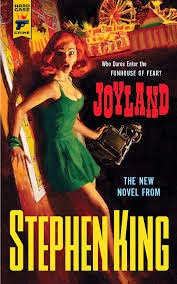
Joyland by Stephen King


This is the fourth book I read as part of my R.I.P. Peril the First activity this fall.  Joyland has been on my TBR list for forever, but I didn't actually have a copy of the book until recently, when I picked up the paperback at a local drugstore.  It seemed fitting to buy it that way, because the whole point of the Hard Case Crimes books (of which this is a volume) is to hark back to the good old days of pulp paperbacks that one would pick up from a rack at the corner store.  (In fact, even in these days of electrons and Kindles, pretty much every time I go to the drugstore I swing by the paperback books display and run my eyes over the titles, because books.)


At its core, Joyland is the story of a string of unsolved murders, all of young women and all occurring at carnivals or amusement parks.  However, it also serves as a kind of coming-of-age story for the protagonist/narrator.  Devin Jones, a college kid, happens to be spending his summer and fall working at Joyland, a beachside amusement park along the lines of something like Coney Island.  And this amusement park has a gruesome event in its history: a young woman was found dead in the haunted house ride, hours after she had been on the ride with her date, a suspect who vanished into thin air.  Now, as park lore would have it, her ghost can be seen periodically on the ride.  As Devin works at the park through the summer and into the fall, he begins to be curious about the murder, and especially begins to wonder if her murderer might still be at the park, now working incognito alongside him.

Devin also begins to make friends with a little boy named Mike, and his mother, Annie Ross.  The Rosses live in a house on the beach, and Devin sees them every day as he walks to work.  Mike has muscular dystrophy and spends much of his time in a wheelchair, and Annie spends much of her time trying to (over)protect him from every little thing.  However, Mike is ready to live a little, because he knows his time is limited, so he recruits Devin to help his mother get over her over-protectiveness. Devin helps Mike learn how to fly a kite, and eventually works it out so Mike can get his own private after-hours tour of the amusement park.  An interesting twist is that Mike has ESP (as so many of King's characters do) and can communicate with the dead.  This leads to some interesting plot developments, including the climax of the book, which includes a murderer, a hostage, and an out-of-control ferris wheel.

As an aside, what is it about carnivals and amusement parks that both attracts and unnerves us?  Maybe it's the sense that, underneath the bright lights and happy music, there's a darker underbelly that can be menacing and dangerous.  I'm sure this was not Mr. King's intention, but the climax of this book and the deal with the ferris wheel put me in mind of one of the most terrifying scenes in all of Hitchcock's movies -- the horrific carousel scene in Strangers on a Train:


That scene makes my heart race every time I watch it, even though I know what is going to happen, and this book had many similar moments.  I enjoyed reading Joyland and I would highly recommend it!