
Showing posts with label The Bazaar of Bad Dreams. Show all posts

Monday, February 11, 2019

DMI2017, Week 29: "Mister Yummy" by Stephen King

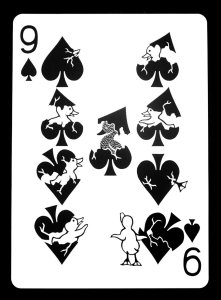
nine of spadesBazaar


This week’s story, brought to us by the Nine of Spades, comes once again from Stephen King’s newest (I think) collection of short stories, The Bazaar of Bad Dreams. One of the things that makes this collection so interesting (besides, of course, the excellent stories themselves) is King’s short preface to each story, wherein he gives some background or insight into why he wrote the story or where he got the idea for the story.
For the story “Mister Yummy,” King recalls talking to a friend about wanting to write a story involving gay men in the era of AIDS. His friend told him that he probably didn’t have anything new to say about AIDS, especially as a straight writer. But King strongly disagrees, and this story bears out the validity of his viewpoint. King says that the power of the human imagination is such that anyone should be able to write a story about anything. He points out that when we talk about imagination, we’re really talking about empathy — it all just boils down to understanding what it’s like to be someone else. If we as a society have lost the ability of empathizing with others in our world, then there’s no hope for us. I completely agree with King here.
The other thing I liked about this story was King’s use of Poe’s “The Masque of the Red Death” as a sort of counterpoint to the events of the story. I took the opportunity this week to re-read that story, so in case you haven’t read it, here’s a brief synopsis: despite the best efforts of Prince Prospero to protect himself and everyone in his castle from the menace of the Red Death, he fails. One night during a masquerade ball, The Red Death sneaks in — disguised, oddly enough, as the Red Death.
In “Mister Yummy,” King turns the tables on Poe’s idea. In this story, Death appears as a beautiful, sexy, and utterly desirable young man who shows up one night at a gay bar in the era of AIDS. The story is being told many years later by Ollie Franklin, an elderly gay man living in an assisted living facility. Ollie and his friends nicknamed this young man “Mister Yummy,” and now Ollie is reminiscing about him because he has seen him in various places around the retirement home. The odd thing is, Mister Yummy looks exactly as he did the night Ollie first saw him, decades ago. He begins to think that Mister Yummy is really Death, and is coming for him soon. Every time he sees Mister Yummy, he’s closer and closer, and eventually he will show up in Ollie’s room, and that will be the end.
He tells all this to his friend, Dave, who is more or less incredulous. However, Ollie is insistent that he’s going to die soon, and wants to give Dave his most treasured possession, an antique pocket watch, so his good-for-nothing younger brother won’t get his hands on it. Dave agrees to take it, and soon after, Ollie is discovered in his room, having died peacefully in his sleep.
Dave, of course, has his own “Miss Yummy” that he remembers from his youth, a beautiful young redhead with a too-short skirt that had the propensity to ride up at opportune moments, and it’s not too long before he sees her standing next to the fountain outside the nursing home.
There’s not a whole lot more to the story than that, plot-wise, but this is a beautifully written story that definitely rewards the reader. I also found it a bittersweet meditation on aging and memory, as Dave thinks about his life in the retirement home, and what it all means.
Rating: 5 stars; I have a feeling this is a story I’ll be re-reading many more times.
Deal Me In 2017 is hosted by Jay at Bibliophilopolis.

Tuesday, February 7, 2017

DMI2017, Week 5: "Morality" by Stephen King

The story this week is brought to you by the Queen of Spades, from Stephen King's recent collection The Bazaar of Bad Dreams. This story was originally published in Esquire magazine.


I came to this story with high hopes based on its premise: morality is a slippery slope, and the simplest, seemingly non-consequential act can lead to things that are not so simple and non-consequential. Maybe I misunderstood its premise, or maybe this was the wrong story at the wrong time, or maybe it's just a not-so-good story -- but whatever the reason, I wasn't feeling this story this week.

The plot, however, is simple. Chad and Nora, a young married couple, have money issues. Chad is a substitute school teacher but has dreams of writing a book, and he's halfway there with an offer from a real agent, if he can only free up enough time to get the writing done. Nora works as a private home health nurse for a retired minister by the name of George Winston. Her job is all that's keeping them afloat, but things may get better soon: the Reverend Winston has proposed an arrangement that will put them solidly in the black for a long time, long enough certainly to allow Chad to finish his book and get it published.

But here's where the story goes off the rails for me. Reverend Wilson is fabulously wealthy, through a combination of old family money and plain living, and he proposes a deal with Nora. He has never really sinned in his life, he says -- at least, nothing major. But here at the end of his life, he's curious and now wants to see what it's like. The only problem is, he's bedridden and housebound, so he has to do his sinning vicariously through someone else, and that's where Nora comes in. He offers her $200,000 to commit a sin of his choosing and produce verification of the same on video. The story does get very interesting at this point, because the creepy, manipulative way in which Winston entices Nora into the deal shows that he's much more acquainted with sin than he might think. Either that, or he's completely clueless about it, despite his position as a well-respected minister.

King keeps the reader in suspense for as long as possible about what sin Nora is going to have to commit. I won't give the story away by telling what it is, but hopefully it's not spoiling the story too much to say that, while shocking and violent, the sin turns out to be not so awful. But maybe that's the point. The effect of the sin on Nora, Chad, and their relationship turns out to be much more consequential. Nora becomes more violent in her dealings with others, and Chad's writing loses the spark that made it appealing in the first place. And their marriage generally just falls apart. In fact, nothing ends well in this story.

So while this was a good story and well worth the time, I was not as enamored of it as some of King's other stories. Maybe I was just expecting a good horror story and got a philosophical drama instead. Still, it ranks four stars with me.

Deal Me In 2017 is hosted by Jay at Bibliophilopolis.

Saturday, January 28, 2017

DMI2017, Week 1: "The Little Green God of Agony" by Stephen King

This story, chosen for me by the Jack of spades, appears in the recent collection of Stephen King's stories entitled The Bazaar of Bad Dreams. And let me tell you, it is classic Stephen King. It's a testament to the fact that, no matter what his literary ups and downs may have been over the years, he very much still has "it." In fact, while I was reading this story I noticed that my heart had started racing and my breathing had sped up -- it was that suspenseful and so effortlessly had sucked me in.


The story opens as Katherine MacDonald, a private nurse, is tending to her patient, Andrew Newsome, who just happens to be the sixth-richest man in the world. He also happens to be a bed-ridden invalid recovering from a plane crash and who is never going to get any better despite the daily physical therapy Katherine ("Kat" for short) tries to give him. I say "tries" because Newsome is, in Kat's eyes, a big baby who can't tolerate the slightest bit of pain, and certainly not the monumental amounts of pain that such physical therapy requires to make any kind of progress back to normal functioning of muscles and legs and such. (In the introduction to this story, King notes that he was inspired by his own painful recuperation after the 1999 accident in which he was almost killed by a motorist.)

Even though Kat thinks Newsome is the ultimate wimp, she dares not say anything along these lines to her rich and powerful employer, because she's sure he would fire her on the spot. So she keeps her mouth shut as Newsome relates the details of his accident and then worldwide (yet fruitless) search for someone to help him relieve the pain he is in, and finally get better. He's telling all this to a visitor, a faith healer by the name of Rideout. Kat has seen his kind before, she thinks, and he's just another con artist to her. As the story turns out, of course, she is very much mistaken.

Rideout patiently and silently listens to Newsome's tale, and then pronounces his diagnosis and remedy. In his expert opinion, Newsome is possessed by a demon, a "little green god of agony" who has infested his body and is happily feeding on, and amplifying, his pain. He offers to expel the demon in return for just enough money to rebuild his church, which has recently been destroyed in a fire. This surprises Newsome, who is rich (and desperate) enough to give Rideout any amount of money he asks for if he succeeds, but he happily agrees to the request and consents to the exorcism.

NOT the "little green god of agony"

And this is where Kat completely loses it. She gets in Newsome's face and finally tells him off, in no uncertain terms. She tells him exactly what she thinks about this situation, and tells him he is never going to get any better unless he starts biting the bullet in terms of his therapy. Newsome fires her immediately, of course, but Rideout intervenes, saying that if Kat goes, then he goes as well. He welcomes her unbelief, as it turns out, and is eager to show her how wrong she is. He confronts her as a burned-out caregiver who no longer has the empathy necessary to care for her patients and appreciate their pain, and he's ready to give her a lesson in "humility," as he puts it.

Without giving away any more of the story, suffice it to say that, since this is a Stephen King story, Rideout is  right -- there IS a "little green god of agony" inside Newsome and Kat does get her lesson in humility, as well as a lesson in terror. The story has a nice, Stephen King-like ending as well, if you know what I mean.

I would give this story 5 stars (I think I'll try a rating system this time around) and I recommend it highly as a fast, fun read. It was a great start to my Deal Me In journey this year.

Deal Me In 2017 is hosted by Jay at Bibliophilopolis.